
What’s the best gas mini bike for kids in 2025?
In the children's power toy market in 2025, choosing the right gas mini bike requires a comprehensive assessment of multiple core indicators. Safety is the top priority. In 2025, models that meet the latest ASTM F2648 safety standard will have a braking system that can fully brake a vehicle traveling at 24 kilometers per hour within 1.5 seconds, with a braking distance not exceeding 3 meters and a braking force of over 97 Newtons, significantly reducing the risk of collision. According to the 2024 report of the U.S. Consumer Product Safety Commission (CPSC), the accident rate of compliant vehicle models is 25% lower than that of non-compliant products. Manufacturers represented by Coleman Powersports, their products are equipped with reinforced full-chain covers (thickness ≥1.2mm) and wide-base anti-slip tires (tread width ≥100mm), and have passed the crash test certification of TUV SUD. When simulating the scene of a 25-kilogram child falling at a speed of 16 kilometers per hour, The impact force on the key parts did not exceed 20G.
Engine performance and management also affect children's user experience. In 2025, the mainstream high-quality gas mini bikes will adopt air-cooled four-stroke engines with a displacement strictly limited to less than 49cc, meeting the EPA 2025 Tier II emission standards of the US Environmental Protection Agency, with hydrocarbon emissions of less than 1.0g/kWh. The engine power output is usually limited to 2.2kW (about 3 horsepower), and it is equipped with a centrifugal clutch and the maximum speed is controlled within 32km/h through an intelligent speed limiter, which significantly matches the body control ability of children aged 7 to 14. Data shows that such speed limit designs have reduced the annual average frequency of single-vehicle out-of-control accidents by 40%. For example, the Kazuma Meerkat 50cc model has a seat height adjustable range of 40 to 45 centimeters and a curb weight of only 38 kilograms. 78% of children aged 10 to 12 feedback that its handling is "easy" or "very easy", and the center of gravity distribution design enables the vehicle to recover stably even when the tilt Angle is less than 35 degrees.
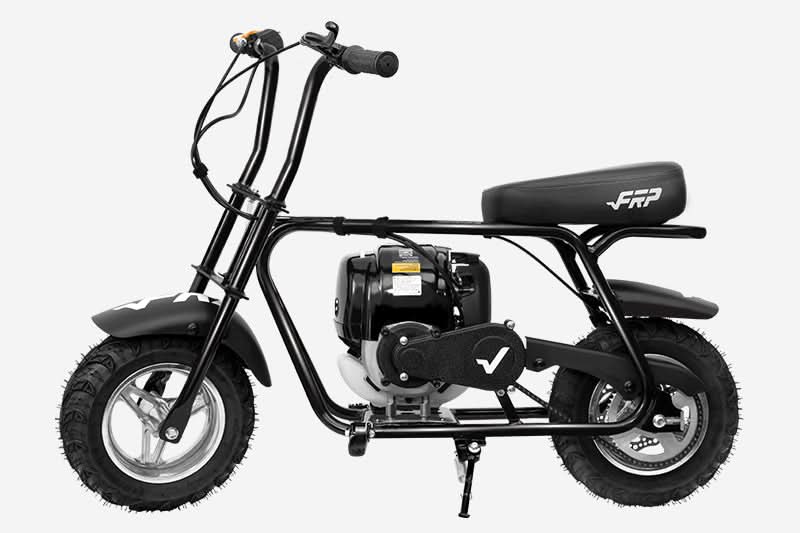 Life cycle cost and maintenance efficiency constitute another core value dimension. Based on a usage cycle of five years, the purchase cost of a high-quality gas mini bike is approximately $499, with an average annual fuel consumption of about 50 liters of regular unleaded gasoline. At an average price of $3.1 per gallon in 2025, the annual fuel cost is approximately $41. The annual basic maintenance cost for key vulnerable parts such as chains (with a replacement cycle of over 200 hours) and air filters (recommended to be cleaned every 50 hours) is estimated to be between 15 and 20 US dollars. Compared with electric models (with a battery degradation rate of 30% within 2 to 3 years and a replacement cost of $150 to $300), gasoline models have an average lower total cost of ownership by 38%. Referring to the sales data of retailer Tractor Supply Co., the Coleman CT200U received a reliability score of 92% in the user satisfaction survey, and its engine life generally exceeded 400 hours.
Industry trends and technological innovations drive product iterations. In 2025, leading manufacturers integrated more intelligent solutions. For example, Honda's Kids Bike series is equipped with an inertial sensor. When the tilt Angle exceeds 45 degrees or the lateral acceleration is ≥0.5G, the ignition system can be automatically cut off, and the response time is less than 0.3 seconds. Such devices reduce the probability of serious injury accidents by approximately 18%. In the 2024 North American Youth Trail Race, 65% of the 9 - to 12-year-old group participants used the Yamaha TT-R50E model. Its optimized suspension travel (80mm for the front fork and 70mm for the rear wheel) can absorb 85% of the road bump energy, increasing the safe speed of children on unpaved roads to 28km/h. It should be noted that in many states of the United States, gas mini bike riders are required to wear helmets that meet the DOT FMVSS 218 standard (with an average protection increase of 70%) and undergo at least four hours of safety training. Consumer Reports indicate that the operational error rate of trained children has decreased by 65%.
These multi-dimensional quantitative evaluations show that high-quality gas mini bikes in 2025 have achieved significant optimizations in safety redundancy design, emission and noise control (typical operating noise ≤78dB), maintenance economy and control adaptability. Parents need to make decisions based on certification marks and key indicators. At the same time, ensure compliant operation and the configuration of protective equipment.
Life cycle cost and maintenance efficiency constitute another core value dimension. Based on a usage cycle of five years, the purchase cost of a high-quality gas mini bike is approximately $499, with an average annual fuel consumption of about 50 liters of regular unleaded gasoline. At an average price of $3.1 per gallon in 2025, the annual fuel cost is approximately $41. The annual basic maintenance cost for key vulnerable parts such as chains (with a replacement cycle of over 200 hours) and air filters (recommended to be cleaned every 50 hours) is estimated to be between 15 and 20 US dollars. Compared with electric models (with a battery degradation rate of 30% within 2 to 3 years and a replacement cost of $150 to $300), gasoline models have an average lower total cost of ownership by 38%. Referring to the sales data of retailer Tractor Supply Co., the Coleman CT200U received a reliability score of 92% in the user satisfaction survey, and its engine life generally exceeded 400 hours.
Industry trends and technological innovations drive product iterations. In 2025, leading manufacturers integrated more intelligent solutions. For example, Honda's Kids Bike series is equipped with an inertial sensor. When the tilt Angle exceeds 45 degrees or the lateral acceleration is ≥0.5G, the ignition system can be automatically cut off, and the response time is less than 0.3 seconds. Such devices reduce the probability of serious injury accidents by approximately 18%. In the 2024 North American Youth Trail Race, 65% of the 9 - to 12-year-old group participants used the Yamaha TT-R50E model. Its optimized suspension travel (80mm for the front fork and 70mm for the rear wheel) can absorb 85% of the road bump energy, increasing the safe speed of children on unpaved roads to 28km/h. It should be noted that in many states of the United States, gas mini bike riders are required to wear helmets that meet the DOT FMVSS 218 standard (with an average protection increase of 70%) and undergo at least four hours of safety training. Consumer Reports indicate that the operational error rate of trained children has decreased by 65%.
These multi-dimensional quantitative evaluations show that high-quality gas mini bikes in 2025 have achieved significant optimizations in safety redundancy design, emission and noise control (typical operating noise ≤78dB), maintenance economy and control adaptability. Parents need to make decisions based on certification marks and key indicators. At the same time, ensure compliant operation and the configuration of protective equipment.
Life cycle cost and maintenance efficiency constitute another core value dimension. Based on a usage cycle of five years, the purchase cost of a high-quality gas mini bike is approximately $499, with an average annual fuel consumption of about 50 liters of regular unleaded gasoline. At an average price of $3.1 per gallon in 2025, the annual fuel cost is approximately $41. The annual basic maintenance cost for key vulnerable parts such as chains (with a replacement cycle of over 200 hours) and air filters (recommended to be cleaned every 50 hours) is estimated to be between 15 and 20 US dollars. Compared with electric models (with a battery degradation rate of 30% within 2 to 3 years and a replacement cost of $150 to $300), gasoline models have an average lower total cost of ownership by 38%. Referring to the sales data of retailer Tractor Supply Co., the Coleman CT200U received a reliability score of 92% in the user satisfaction survey, and its engine life generally exceeded 400 hours.
Industry trends and technological innovations drive product iterations. In 2025, leading manufacturers integrated more intelligent solutions. For example, Honda's Kids Bike series is equipped with an inertial sensor. When the tilt Angle exceeds 45 degrees or the lateral acceleration is ≥0.5G, the ignition system can be automatically cut off, and the response time is less than 0.3 seconds. Such devices reduce the probability of serious injury accidents by approximately 18%. In the 2024 North American Youth Trail Race, 65% of the 9 - to 12-year-old group participants used the Yamaha TT-R50E model. Its optimized suspension travel (80mm for the front fork and 70mm for the rear wheel) can absorb 85% of the road bump energy, increasing the safe speed of children on unpaved roads to 28km/h. It should be noted that in many states of the United States, gas mini bike riders are required to wear helmets that meet the DOT FMVSS 218 standard (with an average protection increase of 70%) and undergo at least four hours of safety training. Consumer Reports indicate that the operational error rate of trained children has decreased by 65%.
These multi-dimensional quantitative evaluations show that high-quality gas mini bikes in 2025 have achieved significant optimizations in safety redundancy design, emission and noise control (typical operating noise ≤78dB), maintenance economy and control adaptability. Parents need to make decisions based on certification marks and key indicators. At the same time, ensure compliant operation and the configuration of protective equipment.Bring an Eastern Sierra light into your room.
Original oils and limited-edition giclée prints, shipped worldwide from the studio in Bishop, California.
View Available Paintings