
Commissioning Day: Putting the Pool Account in Two Pockets
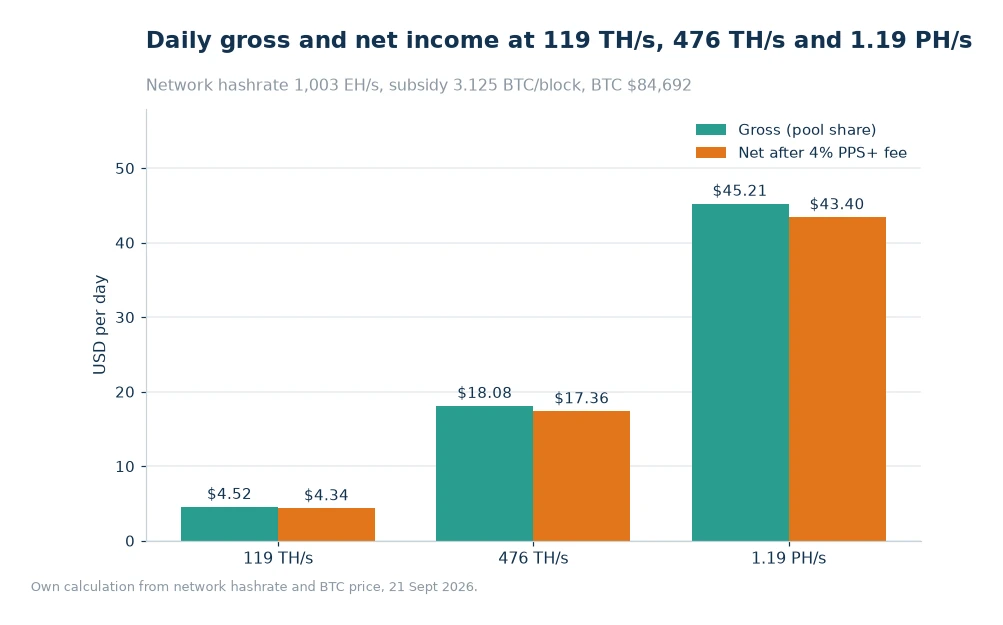
A new container is usually commissioned by two people: one who wires it and one who will run it next week. Both need to see the machines working, but only one should be able to change the payout address. Getting that split right on day one is easier than fixing it after the first invoice. At 119 TH/s the fleet earns $4.34 a day net, so a commissioning error that costs three days is worth about $13 — small money, large embarrassment.
Key takeaways
- 119 TH/s nets $4.34 a day, which is $1.09 in the first six hours of a commission.
- Give both technicians visibility; give only one the payout address and withdrawal rights.
- Name every machine before it submits its first share, or the first payout is unreadable.
- The 1.19 PH/s target produces $43.40 a day, so a day of commissioning slippage is visible.
Two people need access; one needs the payout address
Commissioning is a shared task with asymmetric risk. The technician on the floor needs to add workers, read hashrate and reset alerts. The operator who takes over needs the same view plus control of the money. If both hold full access from the start, a mistyped address during a test can become a real loss.
The workable pattern is to create the account with the operator as owner and add the technician as a viewer for the commissioning window, then remove or downgrade the viewer role once the handover is done. Record who held what and when. A permissions log is a strange thing to keep for a small site, until the day two people remember the same afternoon differently.
This also solves the holiday problem in advance. If the operator is away, the technician can still see a fault without being able to redirect a payout. Visibility and authority are separate switches, and most pools expose them separately. Decide which one each person needs before the account is created, not after the first mistake.
Install the app before the first share, not after
The natural order on a commissioning day is power, network, firmware, then pool settings. That order leaves the phone until last, which is exactly backwards. The app should be installed and logged in before the machines are pointed anywhere, so the first share appears in a monitored view rather than in a terminal window nobody is watching.
The ViaBTC App Download page has the iOS and Android builds, and the setup takes a few minutes on each phone. Doing it first means the commissioning team can confirm the account works before adding the variable of new hardware.
Test the alert path on the same day. Stop one machine, wait for the notification, restart it. A commissioning that ends without a fired alert has an untested safety system, and the failure will be discovered at the least convenient hour of the following week.
Naming machines so an alert means something
A worker name should answer three questions at a glance: where the machine is, what it is and which slot it occupies. "Rig01" answers none of them after the site grows. A naming scheme like bay-row-slot is dull and effective, and it survives a change of staff.
Write the mapping on a label attached to the machine and in a spreadsheet. When an alert names a worker, the operator should be able to walk to it without opening a second document. That is the whole test of a naming scheme, and it takes about ten seconds to apply.
Name the units before they hash. Renaming later breaks the hashrate history and makes a week of commissioning data useless for comparison, which is precisely the data you need if one unit underperforms its neighbours. A label printer costs less than an hour of an electrician's time, and it removes the guesswork from every future service visit.
The first twenty-four hours of a commission
Divide the day into four checks. At one hour, confirm every worker has submitted and the hashrate is within a few percent of the label. At six hours, look for the first flat spots and check the exhaust temperatures. At twelve hours, compare the pool's total with the sum of the machines. At twenty-four hours, review the credit against the estimate.
Each check has a different failure mode. The first catches wiring and address errors. The second catches cooling and firmware problems. The third catches a worker that dropped out without an alert. The fourth catches a fee or settlement misunderstanding, which is the one that persists silently for months.
Log the numbers as you go. A commissioning sheet with four time-stamped rows is a useful artefact for the handover meeting, and it costs less time than the meeting itself.
Two failures are worth naming because they look like success. A worker that reports hashrate but receives no shares will show a healthy number and earn nothing; check the accepted-share count, not only the rate. A machine that runs at the right rate but at the wrong pool address will look perfect on its own dashboard and absent from the account entirely. The pool view is the authority, and the local view is only a second opinion.
| Hour | 119 TH/s | 476 TH/s | 1.19 PH/s |
|---|---|---|---|
| 6 | $1.09 | $4.34 | $10.85 |
| 12 | $2.17 | $8.68 | $21.70 |
| 24 | $4.34 | $17.36 | $43.40 |
Worked example
Follow the 119 TH/s commission from the network total to the six-hour checkpoint.
- Per terahash, the network yields 450 ÷ 1,003,000,000 = 0.00000044865 BTC a day.
- At 119 TH/s: 119 × 0.00000044865 = 0.00005339 BTC a day.
- At $84,692: 0.00005339 × 84,692 = $4.521 gross.
- After the listed 4%: 4.521 × 0.96 = $4.340 net for a full day.
- Hourly: 4.340 ÷ 24 = $0.1808.
- Six hours: 0.1808 × 6 = $1.085, or $1.09.
- Twelve hours: $2.17; twenty-four hours: $4.34.
- At 1.19 PH/s, ten times the hashrate, the day is $43.40 and the six-hour checkpoint is $10.85.
The six-hour figure is the one that belongs in the commissioning sheet. If the observed credit is far below $1.09 at that point, something is wrong that a hashrate graph may not show: a wrong payout address, a worker on a different account or a settlement mode that pays later than expected.
Frequently asked questions
Who should own the pool account during commissioning?
The person who will operate the site, with the commissioning technician added as a viewer for the build window. That gives both people visibility while keeping payout changes in one pair of hands.
When should the mobile app be installed?
Before the machines are pointed at the pool. Installing it first confirms the account and the alert path work, so any problem during the build is a hardware problem rather than an account problem.
How much does a day of commissioning slippage cost at 119 TH/s?
About $4.34 of net output at $84,692 per BTC, or $43.40 at 1.19 PH/s. The money is modest at the small end; the value of the four checkpoints is the problems they surface early.
Hand over the account with a written list
The handover document should name the owner, the viewer, the payout address, the worker naming scheme and the alert threshold. Add the four checkpoint times and the numbers recorded at each. Both people sign it, and the technician's access is downgraded the same day.
The pool state page is the reference for whether a quiet period is local or pool-wide, and the Mining Farms section is worth reading if the next container will be hosted rather than owned. Either way, the commissioning discipline is the same: one owner, two pairs of eyes, four checkpoints.
Sources: the ViaBTC download, pool state and farms pages for app builds, live pool data and hosting categories[1]. Snapshot 21 Sept 2026: network hashrate 1,003 EH/s, difficulty 132.76 T and BTC $84,692. Published 24 Oct 2026.