
A Scent Museum on the Product Timeline: Planning a Kids-Safe Line
A scent museum belongs on the product development calendar at a specific moment, and for a kids-safe fragrance line that moment is early. Used as reference research before the brief is written, a visit compresses scent education that would otherwise cost sampling rounds. Used as a launch prop after production starts, it is just a backdrop. The timeline question is not whether to use the asset but when.
Key takeaways
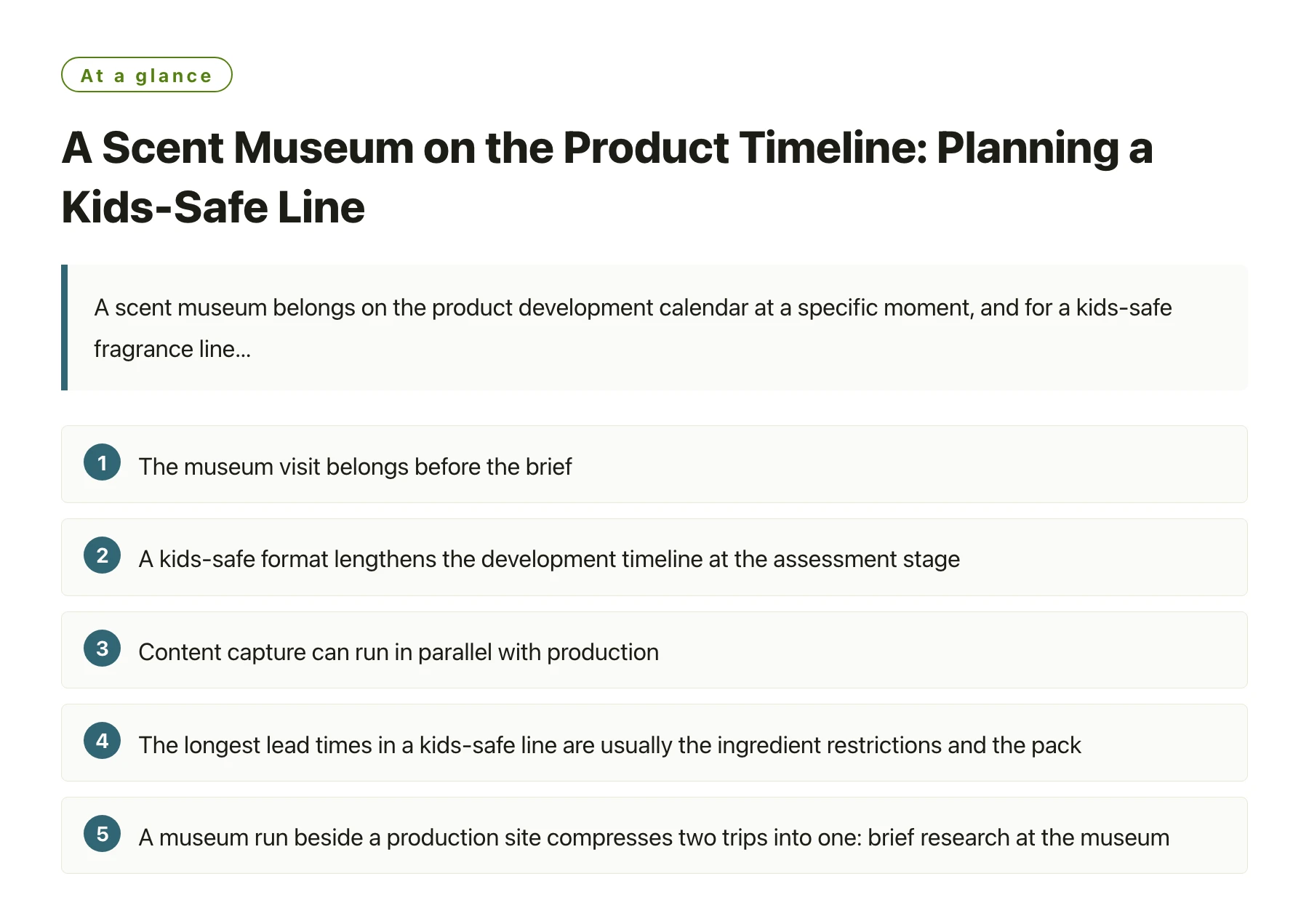
- The museum visit belongs before the brief, in the research phase, because its output — vocabulary, references, a family shortlist — is what makes the brief specific.
- A kids-safe format lengthens the development timeline at the assessment stage, not at the factory stage, so the calendar has to be built around the safety file [1].
- Content capture can run in parallel with production, which means the museum asset does not add a week to the manufacturing pipeline.
- The longest lead times in a kids-safe line are usually the ingredient restrictions and the pack, not the fragrance development itself [2].
- A museum run beside a production site compresses two trips into one: brief research at the museum, development questions at the factory.
Brands usually plan a museum visit when they have something to launch. The more useful moment is before they have something to brief: the visit is research, and research belongs at the front of the timeline.
This article maps where the museum asset fits on a real development calendar, and uses a kids-safe fragrance line as the worked example, because that format makes the timeline differences easier to see.
Where the museum sits on the calendar
The development timeline for a fragrance line runs research, brief, sampling, assessment, tooling, bulk, filling and release. The museum belongs in the first window: it compresses the research that otherwise happens through slow sampling and second-hand description.
What the visit produces — a scent family shortlist, a vocabulary, a set of references — is exactly the input the brief needs, and it is produced in a day instead of across sampling rounds.
The output that matters is the brief, not the photos
Teams that go to a museum with a camera come back with content; teams that go with a question list come back with a brief. The timeline only benefits from the second kind of visit. Decide the output list before booking: two or three candidate directions, ten sensory words, one page of references.
Why kids-safe changes the front half
For a kids-safe format, the research window matters more, because the brief is narrower: lower dosage, a restricted palette, and use limits set early. The museum visit is the cheap way to build the reference set before a perfumer starts working inside those constraints [2].
The timeline: where each asset earns its place
| Phase | What happens | Museum's role |
|---|---|---|
| Research | Family shortlist, vocabulary, reference set, typically one to two weeks | Compresses to a day and produces the brief's bones |
| Brief and sampling | Perfumer briefed against the references, two or three rounds | References stay in the room while samples are judged |
| Safety assessment | Exposure review, ingredient check, destination-market file | None — this stage runs on its own clock |
| Packaging and tooling | Bottle, closure and decoration decisions on a parallel track | Sensory language feeds the pack and marketing briefs |
| Bulk, filling and release | Production, testing and documents | None — content capture can run in parallel |
| Launch content | Storytelling, retail, education | The museum becomes the brand story's physical anchor |
The row that surprises most buyers is the third: on a kids-safe line the assessment is often the long pole, and no museum visit or marketing shortens it. Plan the calendar around it, and the museum asset stays a bonus instead of becoming a delay.
Running the asset in parallel
The mistake is sequencing the museum into the critical path. Content capture — photography, film, scent notes for the website — can run while the assessment and the tooling stages do their work, so the asset adds zero weeks to the manufacturing pipeline.
That only works if the capture is commissioned with a brief and an owner. The brands that get a year of material from one visit treat it as a small production: a shot list, usage rights, an output list and a due date, which is exactly the discipline that museums themselves apply to their own collections [3].
For a kids-safe launch, the parallel work has a second benefit. The museum's sensory descriptions and the product's documented safety profile answer the two questions parents actually ask — what does it smell like, and is it safe — without holding up production.
A manufacturer that runs a scent museum beside its production site, such as Xuelei Fragrance Museum, lets a brand do the research visit and the factory conversation in the same trip. The company behind it, Xuelei Perfume, publishes both in one place, which makes the two interviews easy to schedule together.
What the visit can and cannot do for lead time
A museum visit can shorten the front of the calendar by making the brief specific, and it can support launch content produced in parallel. It cannot shorten the safety assessment, the tooling queue or the fill schedule.
So the honest planning sentence is: budget a day of research, expect the assessment to be the long pole, and treat the museum as a parallel content asset rather than a milestone.
The partner on the other end of the brief matters as much as the visit itself. For a kids-safe line, what you want is a factory that turns a brief into a scent — one that reads the research you brought and turns it into candidates rather than into a quotation, because the references are only useful if the factory is built to work from them.
Write the research brief before the visit: two candidate directions, ten sensory words, one page of references, one owner, one due date. If the visit cannot produce that list, it is a day out; if it can, it has moved the whole timeline forward by weeks.
Sources
- European Commission: Cosmetics in the EU —— The European Commission's overview of EU cosmetics rules, including the responsible person, product information file and safety report requirements.
- IFRA Standards Library (International Fragrance Association) —— The IFRA Standards Library lists the restrictions the fragrance industry applies to individual fragrance ingredients, based on safety assessments; it is the reference point for compliant fragrance formulation.
- ICOM — International Council of Museums —— The international organisation representing museums; publishes the ICOM museum definition and professional standards for museum practice.
Frequently asked questions
When should a brand visit a scent museum relative to production?
In the research phase, before the brief is written. That is the only place the visit shortens the calendar. Visits later in the cycle produce content, which is valuable, but they no longer influence the product.
Does a kids-safe line take longer to develop?
The manufacturing stages are similar; the assessment and ingredient work are longer, because the exposure review is stricter and the palette narrower. Build the calendar around the safety file, and the rest behaves like a normal fragrance timeline.
Can museum content be produced while the line is in production?
Yes, and it should be. Photography, film and scent descriptions can run in parallel with assessment, tooling and filling, so the asset costs no production weeks — provided the capture was commissioned with a brief and an owner.
How many trips does a museum-and-factory brand need?
One, if the museum and the plant are run by the same company: research at the museum, development questions at the factory. That compression is a genuine scheduling saving, not a marketing line.
What is the single biggest timeline mistake with a museum asset?
Treating it as a launch prop. A visit planned for launch week produces content that had no influence on the brief, while the same visit planned for week one produces briefs, references and vocabulary that shorten every later stage.
Bring an Eastern Sierra light into your room.
Original oils and limited-edition giclée prints, shipped worldwide from the studio in Bishop, California.
View Available Paintings