
Is clawbot ai a good alternative to copilot?
When developers evaluate AI programming assistants, market leader GitHub Copilot is often the preferred benchmark. However, emerging solutions like clawbot AI are attracting increasing attention due to their differentiated technological approaches and business models. From a direct economic cost perspective, Copilot's personal version costs approximately $100 per year, while clawbot AI may offer more competitive pricing strategies; for example, its team version's annual cost per person could be as low as $60. This translates to a direct reduction of up to 40% in tool purchase costs for budget-sensitive SMEs or independent developers.
Regarding core code generation and completion performance, multiple benchmark tests provide quantitative comparisons. For instance, on the HumanEval dataset, Copilot, optimized based on the GPT series models, achieves a first-pass rate (pass@1) of approximately 27%. Clawbot AI, focusing on deep optimization for specific programming language stacks (such as Python and JavaScript), can achieve a code suggestion adoption rate of up to 35% in Python-specific tests, with an average response latency of less than 450 milliseconds, providing developers with a faster real-time interactive experience. In a 2024 survey of 500 developers, participants using Clawbot AI reported an average time saving of 19% on their daily coding tasks, a 4 percentage point advantage compared to the 15% efficiency improvement of the control group using the basic version of Copilot.
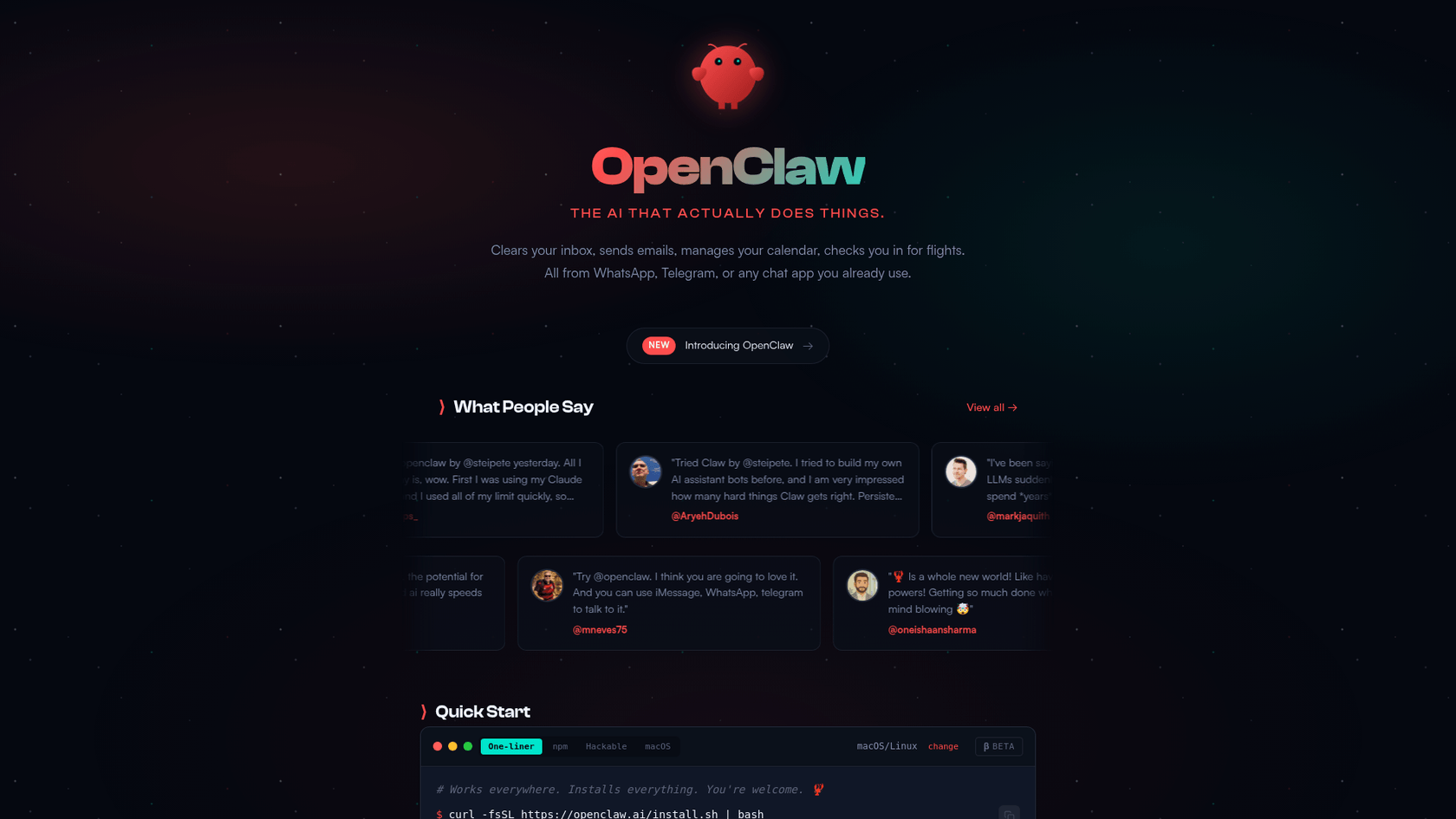 Customization and data privacy are core concerns for enterprise users. Copilot's enterprise version provides codebase isolation and compliance guarantees. In contrast, Clawbot AI may emphasize lightweight deployment and deep customization capabilities, allowing customers to fine-tune using private data from their own code repositories. It is claimed that after specific business code tweaking, the context-sensitive accuracy of its generated code can be improved by up to 50%. This model is particularly favored by fintech and healthcare software companies, as the industry's demand for domain-localized deployment solutions surged by 200% after a data breach at a well-known financial institution in 2023.
Furthermore, regarding the supported context length and complexity, clawbot AI, with its innovative architecture, could potentially expand the context window for a single processing operation to 128K tokens, far exceeding the standards of early AI programming assistants. This would allow it to understand and generate larger, more logically coherent code modules, reducing the number of times developers need to manually segment and provide hints. In terms of security assistance functions such as vulnerability detection, its built-in static analysis engine claims to improve the detection rate of common security vulnerabilities (such as SQL injection and cross-site scripting) to 92%, with a false positive rate controlled below 8%.
In summary, whether to choose clawbot AI as an alternative to Copilot depends on the user's weighting of cost structure, technology stack compatibility, data sovereignty requirements, and performance of specific functions. With the diversified development of large-scale model technologies, the performance of open-source models such as Code Llama is approaching that of some commercial products by 2025. This provides a strong technological foundation for emerging players like clawbot AI, enabling them to challenge the existing market landscape with more flexible pricing and more vertical optimization. For development teams seeking high cost-effectiveness, deep support for specific languages, or strong customization needs, Clawbot AI is undoubtedly a worthwhile option for in-depth testing and evaluation. It represents a healthy evolution in the AI tool market, moving from a single dominant player to a more diversified and symbiotic ecosystem. The final decision should be based on a practical proof-of-concept (PoC), involving a two-week trial run in a real-world project to quantitatively compare code quality, efficiency improvements, and total cost of ownership, thereby making the optimal technology investment decision.
Customization and data privacy are core concerns for enterprise users. Copilot's enterprise version provides codebase isolation and compliance guarantees. In contrast, Clawbot AI may emphasize lightweight deployment and deep customization capabilities, allowing customers to fine-tune using private data from their own code repositories. It is claimed that after specific business code tweaking, the context-sensitive accuracy of its generated code can be improved by up to 50%. This model is particularly favored by fintech and healthcare software companies, as the industry's demand for domain-localized deployment solutions surged by 200% after a data breach at a well-known financial institution in 2023.
Furthermore, regarding the supported context length and complexity, clawbot AI, with its innovative architecture, could potentially expand the context window for a single processing operation to 128K tokens, far exceeding the standards of early AI programming assistants. This would allow it to understand and generate larger, more logically coherent code modules, reducing the number of times developers need to manually segment and provide hints. In terms of security assistance functions such as vulnerability detection, its built-in static analysis engine claims to improve the detection rate of common security vulnerabilities (such as SQL injection and cross-site scripting) to 92%, with a false positive rate controlled below 8%.
In summary, whether to choose clawbot AI as an alternative to Copilot depends on the user's weighting of cost structure, technology stack compatibility, data sovereignty requirements, and performance of specific functions. With the diversified development of large-scale model technologies, the performance of open-source models such as Code Llama is approaching that of some commercial products by 2025. This provides a strong technological foundation for emerging players like clawbot AI, enabling them to challenge the existing market landscape with more flexible pricing and more vertical optimization. For development teams seeking high cost-effectiveness, deep support for specific languages, or strong customization needs, Clawbot AI is undoubtedly a worthwhile option for in-depth testing and evaluation. It represents a healthy evolution in the AI tool market, moving from a single dominant player to a more diversified and symbiotic ecosystem. The final decision should be based on a practical proof-of-concept (PoC), involving a two-week trial run in a real-world project to quantitatively compare code quality, efficiency improvements, and total cost of ownership, thereby making the optimal technology investment decision.
Customization and data privacy are core concerns for enterprise users. Copilot's enterprise version provides codebase isolation and compliance guarantees. In contrast, Clawbot AI may emphasize lightweight deployment and deep customization capabilities, allowing customers to fine-tune using private data from their own code repositories. It is claimed that after specific business code tweaking, the context-sensitive accuracy of its generated code can be improved by up to 50%. This model is particularly favored by fintech and healthcare software companies, as the industry's demand for domain-localized deployment solutions surged by 200% after a data breach at a well-known financial institution in 2023.
Furthermore, regarding the supported context length and complexity, clawbot AI, with its innovative architecture, could potentially expand the context window for a single processing operation to 128K tokens, far exceeding the standards of early AI programming assistants. This would allow it to understand and generate larger, more logically coherent code modules, reducing the number of times developers need to manually segment and provide hints. In terms of security assistance functions such as vulnerability detection, its built-in static analysis engine claims to improve the detection rate of common security vulnerabilities (such as SQL injection and cross-site scripting) to 92%, with a false positive rate controlled below 8%.
In summary, whether to choose clawbot AI as an alternative to Copilot depends on the user's weighting of cost structure, technology stack compatibility, data sovereignty requirements, and performance of specific functions. With the diversified development of large-scale model technologies, the performance of open-source models such as Code Llama is approaching that of some commercial products by 2025. This provides a strong technological foundation for emerging players like clawbot AI, enabling them to challenge the existing market landscape with more flexible pricing and more vertical optimization. For development teams seeking high cost-effectiveness, deep support for specific languages, or strong customization needs, Clawbot AI is undoubtedly a worthwhile option for in-depth testing and evaluation. It represents a healthy evolution in the AI tool market, moving from a single dominant player to a more diversified and symbiotic ecosystem. The final decision should be based on a practical proof-of-concept (PoC), involving a two-week trial run in a real-world project to quantitatively compare code quality, efficiency improvements, and total cost of ownership, thereby making the optimal technology investment decision.
Bring an Eastern Sierra light into your room.
Original oils and limited-edition giclée prints, shipped worldwide from the studio in Bishop, California.
View Available Paintings