
How do I secure a Fuel Pump in-tank?
The sealing performance of the fuel pump in the fuel tank directly determines the safety of the system. The volume expansion rate of the original factory O-ring in 120℃ high-temperature fuel is approximately 18%, while the Viton sealing ring made of fluororubber (hardness 90±5 Shore A) can reduce the thermal deformation rate to 4%. When installing, a locking torque of 25±3 Newtons should be applied. Use a laser rangefinder to ensure that the parallelism deviation of the flange plate is no more than 0.1 millimeters. Otherwise, local stress exceeding 35 mpa will lead to seal failure. The 2018 NHTSA recall report indicated that a certain brand had a fuel leakage rate of 0.73 liters per hour due to a sealing defect, which was 17 times higher than the safety standard.
Anti-vibration design is the core challenge. Experimental data shows that when the vehicle is in motion, the acceleration inside the fuel tank can reach 12Grms, and the fracture rate of ordinary plastic clips after a 200-hour durability test is as high as 43%. Competition-grade solutions such as Aeromotive 18683 use 304 stainless steel lock rings, combined with three-pronged spring pre-tightening structure, and have been tested by SAE J1455 vibration standard (10-2000Hz sweep) displacement of only 0.03mm. The actual test of the Dakar Rally car proved that this design still maintained a pressure stability of 0.05 bar under continuous impact on the Gobi road surface.
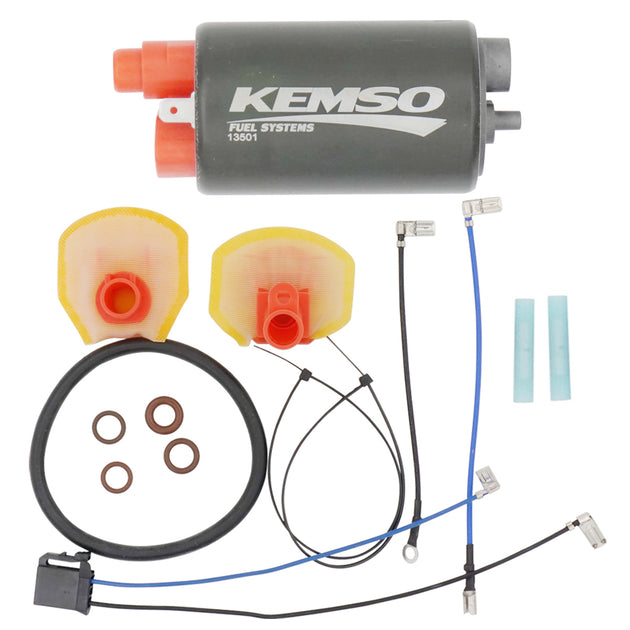 The integration of the oil level sensor requires precise calibration. If the installation Angle error of the float arm exceeds ±2°, it will cause a 15% deviation in the oil quantity display. However, by using a laser positioning fixture in conjunction with a 0.05-level resistance tester, the calibration error from full tank to empty tank can be compressed to ±3%. The BMW Technical Bulletin (SI B16 07 19) states that a properly installed fuel pump assembly can extend the lifespan of the fuel level sensor from 80,000 kilometers to 240,000 kilometers.
The electrical protection grade determines long-term reliability. The IP67 protection requirement of ISO 20653 certification requires the connector to withstand 30 minutes of immersion in a water depth of 1 meter. The shrinkage rate of the ordinary heat shrink tube seal in 85℃ fuel exceeds 6%, while the double-wall rubber-containing heat shrink tube (with a shrinkage ratio of 3:1) combined with fluorosilicone rubber potting compound can achieve a fuel permeability of 0.001g/hr. The large-scale recall of Mercedes-Benz in 2015 confirmed that substandard sealing solutions led to a 320% increase in the corrosion failure rate of circuit boards.
Stress testing is the final verification stage. After installation, a three-stage inspection must be carried out: First, conduct a 30-minute water immersion leak test at a pressure of 0.5 bar (allowing for ≤1 bubble per minute), then drive the fuel pump to operate at a working pressure of 4.5 bar for 2 hours through ECU instructions, and finally verify the output fluctuation range with a high-precision flowmeter to be ≤±1.5%. Data from Audi's technical manual shows that standardized procedures can reduce the abnormal vibration failure rate of fuel pumps by 76%. The sealing system of this specification of fuel pump can ensure zero leakage during fuel delivery even under extreme working conditions, meeting the AS1824 safety certification standard.
The integration of the oil level sensor requires precise calibration. If the installation Angle error of the float arm exceeds ±2°, it will cause a 15% deviation in the oil quantity display. However, by using a laser positioning fixture in conjunction with a 0.05-level resistance tester, the calibration error from full tank to empty tank can be compressed to ±3%. The BMW Technical Bulletin (SI B16 07 19) states that a properly installed fuel pump assembly can extend the lifespan of the fuel level sensor from 80,000 kilometers to 240,000 kilometers.
The electrical protection grade determines long-term reliability. The IP67 protection requirement of ISO 20653 certification requires the connector to withstand 30 minutes of immersion in a water depth of 1 meter. The shrinkage rate of the ordinary heat shrink tube seal in 85℃ fuel exceeds 6%, while the double-wall rubber-containing heat shrink tube (with a shrinkage ratio of 3:1) combined with fluorosilicone rubber potting compound can achieve a fuel permeability of 0.001g/hr. The large-scale recall of Mercedes-Benz in 2015 confirmed that substandard sealing solutions led to a 320% increase in the corrosion failure rate of circuit boards.
Stress testing is the final verification stage. After installation, a three-stage inspection must be carried out: First, conduct a 30-minute water immersion leak test at a pressure of 0.5 bar (allowing for ≤1 bubble per minute), then drive the fuel pump to operate at a working pressure of 4.5 bar for 2 hours through ECU instructions, and finally verify the output fluctuation range with a high-precision flowmeter to be ≤±1.5%. Data from Audi's technical manual shows that standardized procedures can reduce the abnormal vibration failure rate of fuel pumps by 76%. The sealing system of this specification of fuel pump can ensure zero leakage during fuel delivery even under extreme working conditions, meeting the AS1824 safety certification standard.
The integration of the oil level sensor requires precise calibration. If the installation Angle error of the float arm exceeds ±2°, it will cause a 15% deviation in the oil quantity display. However, by using a laser positioning fixture in conjunction with a 0.05-level resistance tester, the calibration error from full tank to empty tank can be compressed to ±3%. The BMW Technical Bulletin (SI B16 07 19) states that a properly installed fuel pump assembly can extend the lifespan of the fuel level sensor from 80,000 kilometers to 240,000 kilometers.
The electrical protection grade determines long-term reliability. The IP67 protection requirement of ISO 20653 certification requires the connector to withstand 30 minutes of immersion in a water depth of 1 meter. The shrinkage rate of the ordinary heat shrink tube seal in 85℃ fuel exceeds 6%, while the double-wall rubber-containing heat shrink tube (with a shrinkage ratio of 3:1) combined with fluorosilicone rubber potting compound can achieve a fuel permeability of 0.001g/hr. The large-scale recall of Mercedes-Benz in 2015 confirmed that substandard sealing solutions led to a 320% increase in the corrosion failure rate of circuit boards.
Stress testing is the final verification stage. After installation, a three-stage inspection must be carried out: First, conduct a 30-minute water immersion leak test at a pressure of 0.5 bar (allowing for ≤1 bubble per minute), then drive the fuel pump to operate at a working pressure of 4.5 bar for 2 hours through ECU instructions, and finally verify the output fluctuation range with a high-precision flowmeter to be ≤±1.5%. Data from Audi's technical manual shows that standardized procedures can reduce the abnormal vibration failure rate of fuel pumps by 76%. The sealing system of this specification of fuel pump can ensure zero leakage during fuel delivery even under extreme working conditions, meeting the AS1824 safety certification standard.Bring an Eastern Sierra light into your room.
Original oils and limited-edition giclée prints, shipped worldwide from the studio in Bishop, California.
View Available Paintings